 |
Stained glass window depicting Philippa of England, Queen of Denmark,
Norway & Sweden at the Vadstena Monastary. Image courtesy of Wikipedia |
Mary, Queen of Scots, also wore a white
wedding gown in 1559 when she married her first husband, Francis Dauphin of
France. She was described as being ‘dressed in clothing as white as lilies, made so sumptuously and richly it would be impossible to describe. Two young ladies carried the marvellously long train’ Although at the time white was the colour of mourning for French
queens, she chose to wear white because it was her favourite colour.
 |
Mary Stuart, shortly before her marriage to the Dauphin Francois of France, 1558.
Image courtesy of Madame Guillotine. |
It is also documented that Henriette-Lucy Dillon, who later became the future marquise de la Tour du Pin, wore a wedding 'gown of white crepe, beautifully trimmed with Brussels lace' in 1787. The reason why she did so, however, is likely due to that fact that she was in 'demi-deuil' or light mourning at the time, following the death of her mother, and not because of any other wedding tradition. This is made clear when she wore a white dress at court presentation a few days later.
These three examples show that prior to Queen Victoria's wedding on the 10th of February,
1840, some brides had already worn white, but not because it had become de rigueur for brides to do so.
Although, having said that, there does seem to have been a changing of perceptions during the 18th century. In the play by Oliver Goldsmith, ‘The Good-Natur’d Man’, first performed in 1768, a maid laments the absence of a white gown for her mistress’ elopement, saying: “I wish you could take the white and silver to be married in. It’s the worst luck in the world, in anything but white.”
 |
Rare hand-painted floral silk wedding gown worn by Mary Chaloner when she married
Colonel John Hale in 1763. Image courtesy of McCord Museum. |
|
|
British 'Robe a la Francaise', of 1775 - 80. Said to have been a wedding dress.
|
|
|
American Wedding Dress worn by Eunice Hooper. Made of Indian embroidered mull,
white with all over silver dots. About 1799. Image courtesy of MFA.
|
White, it seems, was beginning to become a popular choice at the turn of the 19th century - at least for weddings of the nobility and the higher social classes. As these sorts of marriage unions were often more about political
alliances and the transferral of wealth, then about love, brides were expected to dress in a way that cast their families in the most favorable light. Her wedding dress therefore, was a principle way to display the wealth and culture of her family.
 |
The sheer muslin and lace gown thought to have been worn by Elizabeth Patterson when she
married Jerome Bonaparte, brother of Napoleon, on the 24th of December 1803.
Image courtesy of MET.
|
 |
Bridal Dress Fashion Plate from Ackermann's Repository - an early 19th
century English magazine published monthly. Series 2, Vol 1. 1816
Image courtesy of EKDuncan |
|
|
American Wedding Dress featuring elaborate hem detail known as 'Hem Sculpture'.
ca 1824. Image courtesy of MET
|
 |
| Wedding Dress Fashion Plate, January 1827. Image courtesy of LACMA. |
Wealth, of course, could be demonstrated by means of jewellery, but also with textiles. The more elaborate the weave of the fabric, the richer the fibres used, the rarer the colour, the better the display of wealth. Before the development of effective bleaching and cleaning methods, white cloth was highly valued, as it was difficult to achieve and hard to maintain. (In fact, 'white' wedding dresses of the 19th century were actually cream as bleaching silk to a crisp white only became possible in the 20th century). Therefore, wealthy brides often would wear white, not so much to demonstrate their purity, but their prosperity and social status.
|
|
Wedding Dress 1832. French Fashion Print.
|
 |
French Cotton Wedding Dress ca 1837.
Image courtesy of MET |
|
|
Wedding Dress, Wool brocaded with silk. 1837-38.
Image courtesy of LACMA
|
Among the nobility in Europe, however, heavily brocaded gowns
embroidered with real gold and silver thread, were a more common way to
demonstrate wealth, as the following examples show.
 |
An stunning example of a wedding gown worn to a 1730's Russian Imperial wedding, featuring
weaving incorporating silver metallic thread. Image courtesy of MET. |
 |
Stunning silver lace wedding gown of Queen Hedvig (Edwige) Elisabeth Charlotte de Holstein-Gottorp.
ca. 1774. Image Courtesy of Stockholm, Sweden. |
Princess Charlotte, Queen Victoria cousin and aunt (who
would have been queen had she not died tragically in child birth in 1817) was
married to Prince Leopold in a gown of metallic cloth, as had the majority of
brides in the English royal family for centuries prior to her.
|
|
Engraving of Princess Charlotte and Prince Leopold's wedding.
|
|
|
Princess Charlotte's Wedding Dress comprised of a petticoat of
white and silver, worn under a net dress of silver lame. 1816
('Apron' created after alterations to original)
|
So why then did Queen Victoria wear a white gown, when the royal tradition was to
wear one of gold or silver cloth?
The simple answer is because Victoria was no ordinary bride. Unlike the
majority of royal brides, she did not marry as a princess, about to become
Queen Consort. She already
was the Queen,
head of state. Therefore as such she needed to make a statement as the leader
of her country. Thus she chose a gown that would help her make a political
statement, a dress that put her duty to her people and country on display,
rather than her wealth or beauty.
|
|
Wedding of Queen Victoria and Prince Albert.
|
Since one of the biggest concerns in England in the late 1830’s was the effect
that the Industrial Revolution was having on traditional industries, particularly
in the area of lacemaking, Victoria chose to incorporate a large piece of handmade Honiton lace for her gown. As one museum curator put it, she
'saw it as her business to promote all things British', thus her
gown became the means to showcase the unique British-made lace and white was
chosen as the most suitable colour for this purpose.
 |
Detail of Queen Victoria's wedding dress, made of exquisite Honiton lace made in the
village of Beer. Image courtesy of Historic Royal Palaces
|
Much to Victoria’s delight, her wedding widely publicised and copied - though initially her dress was thought to be shockingly plain - causing
a large increase in the number of brides who chose to wear white, as well as
the popularity of handcrafted Honiton lace. However, this didn’t mean that
every bride from the 1840’s onwards now wore white lace gowns at their
weddings. White was still a very expensive colour choice for fabric at this
time, meaning that only wealthy brides could afford a white wedding dress. A
few who just managed to do so did, and then dyed the gown increasingly darker
colours to hide stains so that they could wear it may more times over. However, in France and Scandinavian more practical colours still remained popular particularly among those of modest means, with many brides even choosing to wear black wedding gowns!
 |
Tartan check silk taffeta wedding dress worn by Ellen Whipp, the daughter of a cotton mill
owner, in 1849. Image courtesy of Manchester Art Gallery |
 |
| French black lace wedding gown 1869. Image courtesy of MET. |
 |
Deep red American wedding dress of 1878 in 'Cuirass style', referring to the
form-fitted bodice. Image courtesy of MET. |
By 1849 though,
Godey's Lady Book - the
Good Housekeeping magazine of 19th century America - stated that
"Custom has decided, from the earliest ages, that white is the most fitting hue, whatever may be the material. It is the emblem of the purity and innocence of girlhood, and the unsullied heart she now yields to the chosen one" - completely forgetting that brides wore many different 'hues' through the ages. Roman brides wore yellow. In the middle ages they wore blue, as it was considered the colour of purity and virginity (not white, which had in fact been thought of as the colour of mourning and death at this time), and pale green in the 16th and 17th centuries, due to it's association with fertility.
 |
Pale green figured silk empire line wedding dress worn by Elizabeth Marsden in 1793,
and later also her daughter, Ann, in 1822. Image courtesy of ADR. |
In fact, prior to and well into the 19th century, there was no single customary colour for bridal wear. Women had simply just worn a new 'best' dress, whatever it's colour, and thereafter adapted to so that it could be worn for other occasions, even as maternity wear!
 |
Maria Harper's 1883 wedding dress. Alterations to the skirt is likely evidence that this dress
was not worn only to her wedding, but probably also let out for her seven pregnancies.
Image courtesy of Port Macquarie Historical Society. |
However, it is clear that Queen Victoria's white wedding gown changed societies view of the most suitable colour for bridal wear, and that sentiment, as demonstrated by the following rhyme, continued into the 20th century. (Notice that white and blue are the most preferable options, and the completely changed view of green and black.)
Married in white, you have chosen alright,
Married in green, ashamed to be seen.
Married in blue, love ever true,
Married in grey, you will go far away.
Married in red, you will wish yourself dead,
Married in pink, of you he’ll aye think.
Married in yellow, ashamed of your fellow,
Married in black, you will wish yourself back.
(From Every woman’s Encyclopedia, first published in 1910/1912)
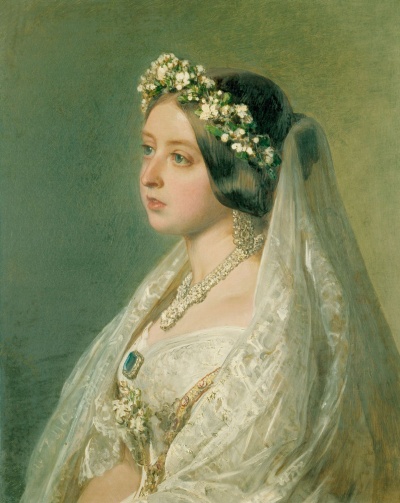 |
Queen Victoria in her wedding dress. Painted by Franz Xaver Winterhalter in 1847 for their
seventh anniversary. Image courtesy of The Royal Collection |


